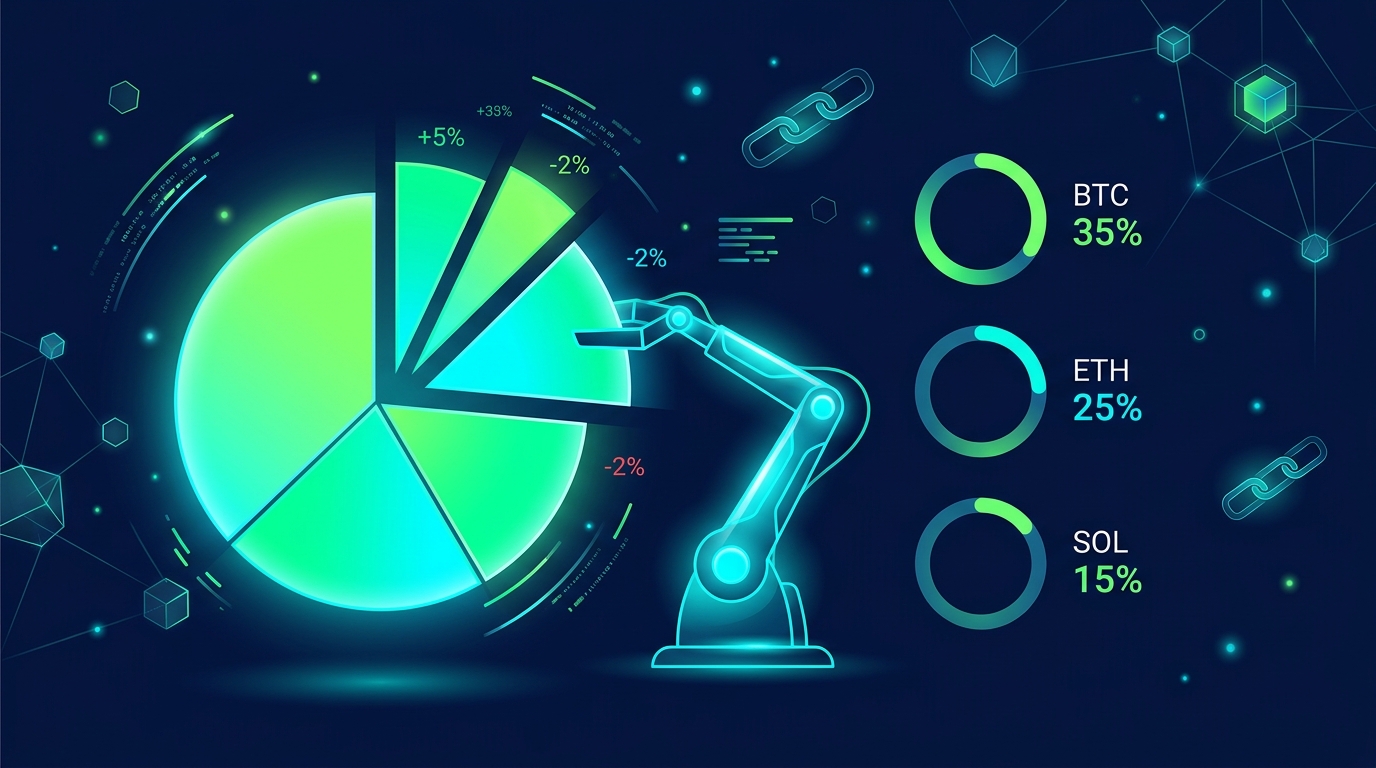
Most crypto investors start with good intentions: 60% Bitcoin, 30% Ethereum, 10% altcoins. Six months later, after Bitcoin doubles and altcoins drop, that portfolio looks nothing like the plan. Rebalancing fixes this — and if you set it up right, you never have to do it manually.
What Is Portfolio Rebalancing?
Rebalancing means selling positions that have grown above your target allocation and buying positions that have fallen below it. The goal is to systematically enforce your strategy rather than letting market movements decide your portfolio composition.
Here's a simple example. You start with 60% BTC and 40% ETH. BTC has a big month, and now your portfolio is 75% BTC and 25% ETH. Rebalancing means selling some BTC and buying ETH to get back to 60/40.
It feels counterintuitive — you're selling what's working. But over longer timeframes, it tends to smooth returns and reduce concentration risk.
Why Manual Rebalancing Rarely Works
Manual rebalancing requires you to notice when your allocations have drifted, calculate how much to trade, execute multiple orders, and handle the tax implications. Most people don't do this consistently. Either they forget, or they get emotional and hold winners too long.
Automation removes the emotion. You define the rules once. The bot executes them.
Threshold vs Time-Based Rebalancing
There are two main approaches:
- Threshold-based: Rebalance whenever any asset drifts more than X% from its target (e.g., trigger when BTC exceeds 70% of portfolio)
- Time-based: Rebalance on a fixed schedule — weekly, monthly, or quarterly
Threshold-based tends to be more responsive to actual market conditions. Time-based is simpler to understand and predict. Many automated tools let you combine both.
Tools That Automate This
Bitsgap
Bitsgap connects to multiple exchanges and lets you define portfolio allocation targets. Its rebalancing features work across BTC, ETH, and dozens of altcoins — you set the target percentages and the tool watches for drift. For traders who already use Bitsgap for grid or DCA bots, adding portfolio rebalancing is a natural extension. Affiliate link — we may earn a small commission at no extra cost to you.
Stoic AI
If you prefer a more hands-off approach, Stoic AI manages your Binance portfolio using quantitative strategies. It's less about user-defined allocations and more about letting an algorithm handle the composition entirely. Good option for people who want to delegate the decision-making entirely. Affiliate link — we may earn a small commission at no extra cost to you.
Coinrule
Coinrule lets you build custom if-then rules without coding. You can set up rules like "if BTC allocation exceeds 70%, reduce by 10% and distribute across ETH and SOL." It's more manual in terms of rule design, but highly flexible. Affiliate link — we may earn a small commission at no extra cost to you.
Tax Considerations for Canadians
In Canada, every crypto-to-crypto trade is a taxable event. This includes rebalancing trades. If you sell BTC at a profit to buy ETH, you've realized a capital gain. Frequent automated rebalancing can create a lot of taxable events, so it's worth thinking about how often you want to trigger rebalances.
Quarterly rebalancing tends to be more tax-efficient than weekly rebalancing for Canadian holders. Some tools also let you set wider drift thresholds (e.g., 15% instead of 5%) to reduce the frequency of trades.
Setting Up Your First Automated Rebalance
Start with three steps. First, decide your target allocation. Keep it simple — two or three assets is enough to start. Second, pick a drift threshold. 10-15% is a reasonable starting point. Third, connect your exchange to a tool like Bitsgap or Coinrule and configure the allocation targets.
Let it run for 90 days before evaluating. The point of automation is consistency, not constant tinkering.
The Honest Trade-off
Automated rebalancing doesn't guarantee better returns than buy-and-hold. In strong bull markets, rebalancing will drag performance by trimming winners. The value is in risk management: it prevents you from accidentally becoming 95% concentrated in a single asset and then watching it correct 50%.
It's a tool for discipline, not for outperforming the market.