What is Tokenomics and Why Smart Investors Study It
Of the roughly 10,000 cryptocurrency projects launched between 2020 and 2023, the vast majority are now effectively worthless. Some failed because of bad technology. Many more failed because of bad tokenomics: the economic design of the token itself was fundamentally broken before a single line of code went live. Understanding tokenomics won't make you immune to bad investments, but ignoring it almost guarantees you'll make some.
What Tokenomics Actually Means
Tokenomics is a combination of "token" and "economics." It refers to everything that determines a cryptocurrency's supply, distribution, and the incentives that govern how people earn, hold, and spend it. Think of it as the monetary policy of a crypto project. Just as you'd want to understand the Bank of Canada's inflation targets before holding Canadian dollars long-term, you'd want to understand a token's emission schedule and allocation before holding it for more than a few weeks.
The key variables that make up a project's tokenomics include total supply, circulating supply, token distribution, vesting schedules, emission rate, burn mechanisms, and utility. Each one affects the others, and none of them can be evaluated in isolation.
Total Supply vs. Circulating Supply
Total supply is the maximum number of tokens that will ever exist. Bitcoin has a total supply of 21 million. Ethereum has no hard cap, but its EIP-1559 burn mechanism reduces net issuance significantly. Solana has a current supply of around 570 million with a declining annual inflation rate.
Circulating supply is what's actually trading in the market right now. This is the number that matters for calculating market capitalization. A token with a $1 price, 10 million circulating supply, and 500 million total supply has a fully diluted valuation of $500 million, but only a $10 million market cap based on what's actually available to trade. When those remaining 490 million tokens hit the market over the next few years, that's 490 million new reasons for the price to fall.
Always look at fully diluted valuation (FDV) alongside market cap. A low market cap that looks attractive can be very misleading if the FDV is 20 times higher.
Token Distribution and Vesting Schedules
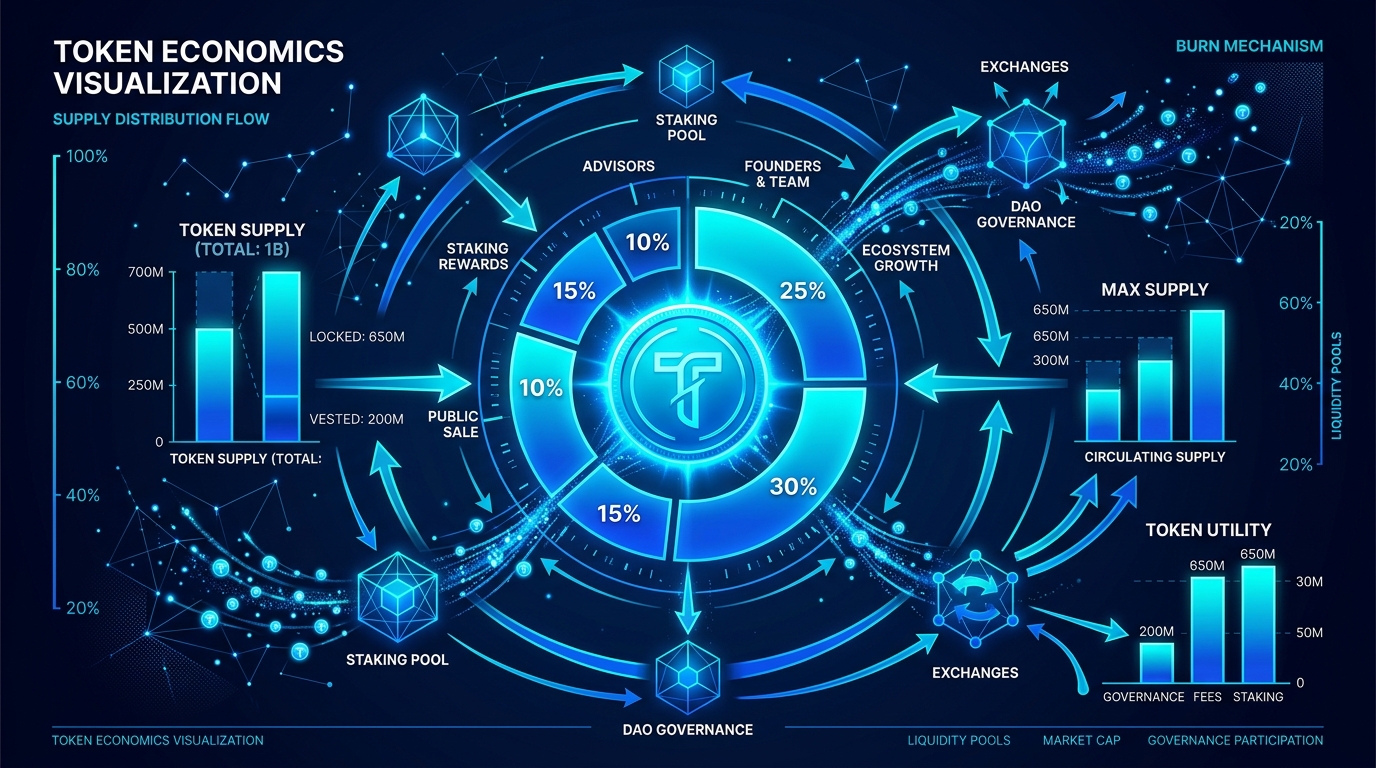
Who owns the tokens and when can they sell them? This is one of the most important questions in tokenomics. A typical token distribution might look like this: 20% to the founding team, 15% to early investors, 30% to ecosystem and development funds, 10% to community incentives, and 25% to public sale.
The founding team and early investors usually have vesting schedules, meaning their tokens are locked and released gradually over time. A common structure is a one-year cliff followed by monthly releases over three years. If a project has a 12-month cliff and you're investing at month 11, you're one month away from a significant unlock event that could create heavy selling pressure.
Token unlock calendars are public for most projects. Sites like Token Unlocks and Vesting.io track upcoming unlock events across hundreds of projects. Checking these before entering a position takes about two minutes and can save you from buying directly before a major sell-off.
Emission Rate and Inflation
Some protocols pay users for participating. Liquidity providers earn trading fees. Stakers earn yield. Validators earn block rewards. All of these payments usually come in the form of newly minted tokens. The rate at which new tokens are created is the emission rate, and it functions exactly like inflation in a traditional economy.
If a protocol is emitting 100% of circulating supply per year in rewards, every token holder is being diluted by half in real terms annually. The yield looks high on paper, 80% APY sounds exciting, but if the token is inflating by 120% per year, you're actually losing purchasing power even while your token count grows.
Sustainable tokenomics requires that token demand grows at least as fast as supply. The best projects have mechanisms that tie token demand to real usage: fees paid in the token, tokens burned on transactions, governance rights that make holding valuable, or protocol revenue shared with stakers.
Utility: What Does the Token Actually Do?
A token with no utility beyond speculation has no fundamental floor. At some point, when sentiment shifts, there's nothing holding the price up. Tokens with genuine utility have structural demand. Users need to buy and hold them to access services, pay fees, or participate in governance. That persistent demand creates a baseline.
When evaluating utility, look for whether the token is required or merely optional. Ethereum's ETH is required to pay gas fees. You can't use the network without it. That's genuine utility. A project where you can do everything with stablecoins and the native token is just a speculation vehicle has much weaker foundations.
Where Automated Tools Fit In
Once you've evaluated tokenomics and decided a project has a solid foundation, the challenge shifts to execution: when to enter, how to size positions, and how to manage them over time. For investors who want exposure to fundamentally sound tokens without monitoring prices daily, tools like Bitsgap offer DCA bots that buy automatically at regular intervals or at price targets you define. A DCA bot removes the emotional component of timing entries and is particularly useful for accumulating positions in tokens where you're confident in the long-term thesis but uncertain about short-term price direction.
(Affiliate disclosure: Gunovula earns a small commission at no extra cost to you if you sign up through this link.)
Bitsgap connects to over 15 exchanges and supports GRID and DCA strategies with adjustable parameters. For someone building a position in an altcoin with strong tokenomics over six to twelve months, a weekly DCA bot can execute that strategy automatically without requiring manual trades. Try Bitsgap's bot trading platform to get started.
A Quick Tokenomics Checklist
Before investing in any crypto project, run through these four checks:
- What's the FDV, and how does it compare to comparable projects in the same category?
- Are there major token unlocks in the next 90 days that could create selling pressure?
- What's the annual emission rate, and does protocol revenue justify it?
- Does the token have genuine required utility, or is it purely speculative?
None of these checks requires a finance degree. They require reading a whitepaper, checking a token unlock site, and looking up the protocol's fee data on a dashboard like Token Terminal. The projects that fail these basic checks aren't necessarily scams. Many are well-intentioned. But good intentions and bad tokenomics produce the same result for investors: losses.
The projects that have built durable value over multiple market cycles, Bitcoin, Ethereum, and a handful of others, all have tokenomics that reward participation, limit inflation, and create structural demand for the asset itself. That's not a coincidence.